There is no federal rule that forces every US carrier to unlock a phone after a set number of days. In July 2024 the FCC proposed one; in January and June 2026 it waived the only 60-day duty that did exist, for Verizon and for a regional carrier, and pointed both at the industry’s own code instead. This guide summarises the FCC’s documents in our own words — the sources below link to the originals. Nothing here is an FCC endorsement of anything.
The 2024 proposal
On July 18, 2024 the FCC adopted a Notice of Proposed Rulemaking (docket 24-186) by a 5–0 vote. In short, it proposed:
- Every mobile provider would unlock a handset 60 days after activation.
- An exception if the provider finds, within those 60 days, that the phone was obtained by fraud.
- The same rule for prepaid and postpaid, applied to newly activated phones rather than existing contracts.
- Questions on whether unlocks should happen automatically, how customers are told, and what it means for financed phones and small carriers.
As of October 5, 2026 no final rule has been adopted in that docket. The FCC’s own list of documents tagged “unlocking” holds the proposal, the two waiver orders below and procedural items — nothing that sets a new rule.
What the FCC did in 2026
| Date | What happened | In plain words |
|---|---|---|
| January 12, 2026 | Order DA 26-43: Verizon’s waiver granted | A 700 MHz licence condition had forced Verizon, and since 2021 its Tracfone brands, to unlock 60 days after activation. The Bureau waived it; Verizon committed to the CTIA code instead (postpaid once paid off, prepaid within a year). The waiver lasts until the FCC settles an industry-wide approach |
| June 5, 2026 | Order DA 26-554: Appalachian Wireless’s waiver granted | The same licence condition waived for a regional carrier on the same commitment, for phones activated from the day after the order |
The FCC’s January release framed the Verizon decision as making the rules more uniform, noting Verizon had been the only major carrier held to 60 days and that the early unlock had become a draw for device fraud. What it means on the ground is in our Verizon 2026 rules guide.
What the FCC consumer guide says
The FCC’s consumer guide (last reviewed January 14, 2025) explains, in our words: a lock is software that keeps a phone built for one network from being activated on another, SIM or eSIM; unless a phone is sold as unlocked, assume it is locked, whoever sold it; a carrier may unlock automatically, send instructions, or do it in a store, and may refuse while money is owed or a contract is unfinished; and an unlock does not promise the phone will work on another network. It also lists the CTIA Consumer Code commitments that the nationwide carriers signed in 2014 and had in place by February 2015.
The CTIA code, carrier by carrier
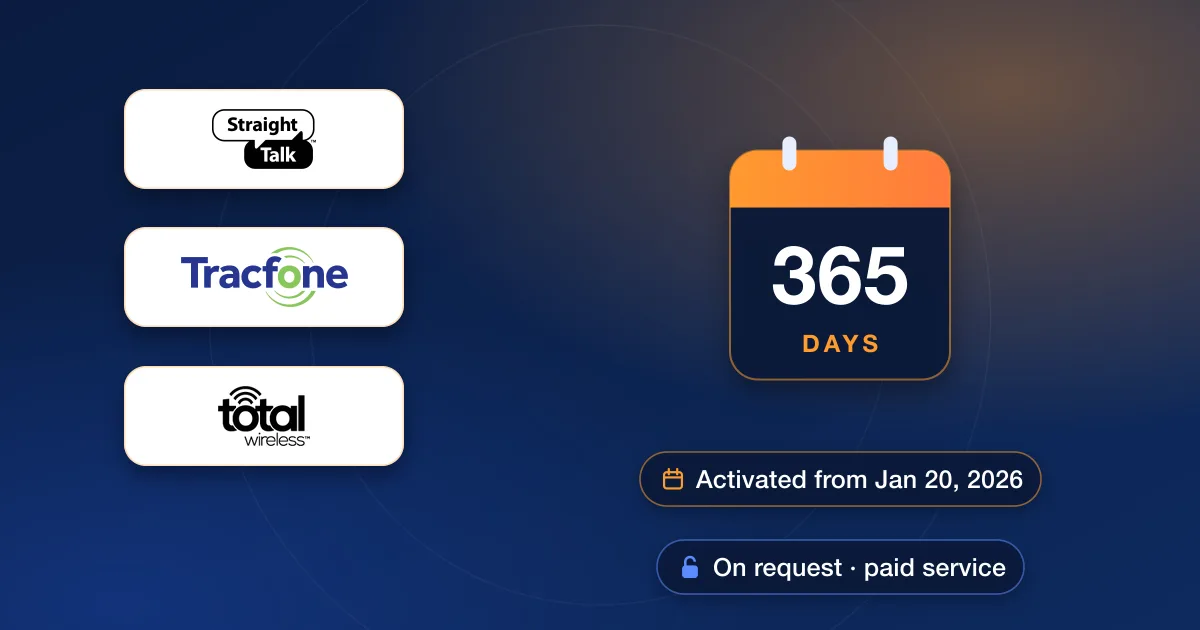
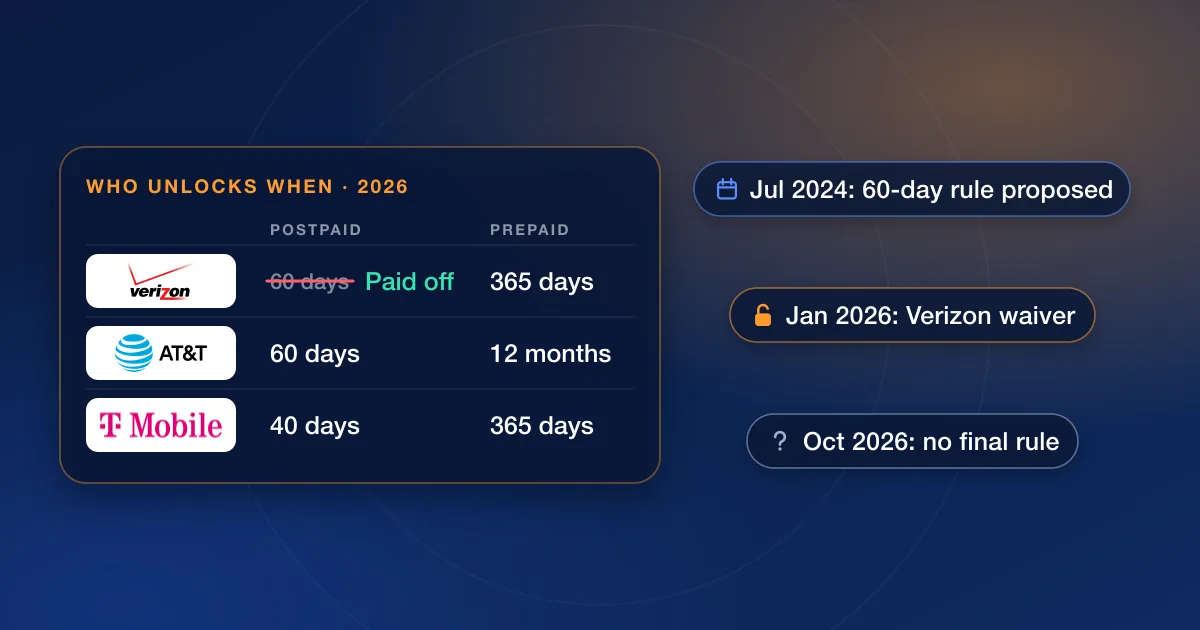
The code is what actually governs your wait today. Postpaid phones unlock on request once the contract or financing is done; prepaid within a year of activation; carriers post their policy, tell you when the phone is eligible or unlock it, answer within two business days, and unlock for deployed military. Each carrier’s own numbers:
| Carrier | Postpaid | Prepaid | Our guide |
|---|---|---|---|
| Verizon | When paid off (phones activated from January 27, 2026) | 365 days on request (from January 27, 2026) | Verizon 2026 rules |
| AT&T | 60 days and paid in full | 12 months of paid service | Is my phone eligible |
| T-Mobile | 40 days and paid in full | 365 days (or the refill route) | Unlock a T-Mobile Galaxy |
| Metro by T-Mobile | — | 365 days | Metro by T-Mobile |
What this means for you
- Unlocking your own phone is lawful; the question is only who does it and when. Is my phone eligible walks through each carrier.
- A carrier can hold the lock while you owe money on the phone. Paying it off is the fastest route on postpaid.
- Prepaid phones now wait up to a year on every major carrier.
- When the wait is the problem — a used phone tied to someone else’s account, a prepaid phone months short — an IMEI unlock is the other route. Our carrier pages list what we offer for each network with live prices.